- Japwa checked official tourism and transport pages on 26 October 2026; recheck routes and exits before booking
- Asakusa and Ueno suit east-Tokyo itineraries in different ways; their rail connections are not interchangeable
- Tokyo–Nihombashi is logical for Shinkansen-heavy plans, while Shinjuku serves the west with a complex station
- No district receives a safety guarantee here; inspect the actual approach, reception and late-entry procedure yourself
01
Start with the longest journey, not the most famous name
Write down three anchors: where you arrive on day one, the area you will visit repeatedly and the station used for your next city. Give a hotel one point for reaching an anchor without a change, one when the correct-exit walk is realistic with luggage, and one when the final evening approach is clear. The area with the strongest score is your best base, even if it is not the fashionable answer.
Do not rely on ‘five minutes from the station.’ Ask which operator, line and exit, and whether the route hides stairs or a long internal passage. Tokyo Metro provides an official barrier-free search for accessible routes and lifts, but a lift somewhere in the station may not be convenient for your hotel. Compare the station diagram with the address before paying.
02
Asakusa: east-Tokyo mornings close at hand
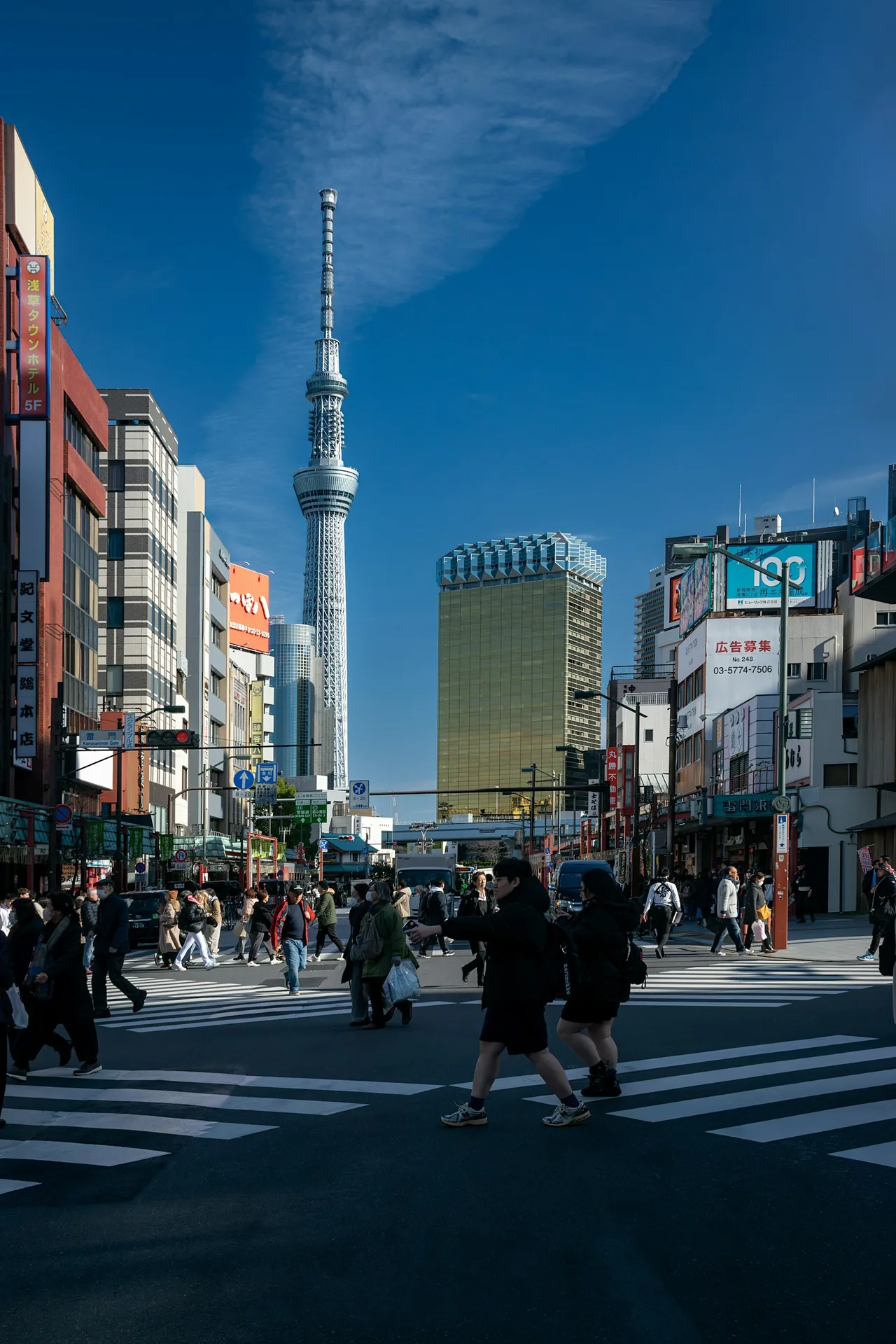
GO TOKYO lists the Ginza, Toei Asakusa and Tobu Skytree lines at Asakusa. That makes the district an intelligible base for Sensoji, Kappabashi, Tokyo Skytree and the Sumida riverfront. Families can place several sights within one side of the city instead of crossing Tokyo before the first activity.
Yet ‘Asakusa Station’ is not a single front door: the operators have distinct station spaces and the walk changes by line and exit. If Shinjuku or Shibuya fills several evenings, calculate the return and transfers rather than only the headline journey time. Asakusa is a route choice, not an automatic promise of quiet or universal convenience.
03
Ueno: useful for Narita, the north and museums
GO TOKYO places Ueno Park, museums and Ameyoko around a major hub served by the Ginza and Hibiya lines, while Keisei serves Keisei-Ueno. Keisei confirms that the Skyliner links Narita Airport with Ueno via Nippori. Ueno therefore becomes a strong base when a Narita arrival, museum days and northbound rail all appear in the same itinerary.
Check the relationship between JR Ueno, Keisei-Ueno and the actual property. ‘Ueno’ is an area, not one platform. With children or luggage, compare lift routes, room layout and luggage storage before celebrating ten minutes saved on an app. In the evening, test the walk from the precise exit rather than trusting a generic neighbourhood label.
04
Tokyo Station and Nihombashi: when intercity trains lead
GO TOKYO describes Tokyo Station as a hub for Shinkansen, the Yamanote Line and Marunouchi Line, with Marunouchi exits to the west and Yaesu toward Nihombashi and Ginza. A nearby base can remove a full transfer from an early Kyoto train or a late intercity return, which may matter more than a cheaper room farther away.
The district is broad, and ‘Tokyo Station’ in a hotel description may still place you on the inconvenient side for your platform. Fix the exit name, confirm late reception and decide whether your group needs laundry, a kitchenette or luggage space. We do not publish fixed prices: compare the final total and cancellation terms for your actual dates.
05
Shinjuku: western connections and late energy
GO TOKYO lists a dense network around Shinjuku: JR, Keio, Odakyu, Tokyo Metro and Toei services, plus nearby stations carrying the Shinjuku name. That reach suits itineraries centred on western Tokyo, private-rail day trips or travellers who want late dining and shopping choices.
The same reach creates complexity. A hotel on the ‘other side’ of the station can add corridors and walking to every evening. Save the exit name and a nearby junction, then preview the street route at your expected arrival time. ‘Near Shinjuku’ does not guarantee a simple approach, and this guide does not provide a personal-safety guarantee for any street.
06
The family filter and the solo-traveller filter
Families should start with the room: are the beds permanent, or does the seating area disappear each night? Is laundry in the room or clearly available? Will the property hold bags before check-in and after check-out? Then inspect the lift route, a nearby food shop and breakfast timing. Those specifics are more useful than an undefined ‘family friendly’ badge.
Solo travellers should test the final 500 metres. Review the current route, identify reception and staffed hours, understand entry after closing, and save the Japanese address and an offline map. Check the last train on the actual day instead of copying an old post. These are general planning precautions, not a security assessment or guarantee.
07
Japwa’s five-question test
Ask: what is my longest repeated journey, how many changes does it need, which exit is correct, is there a usable lift route, and how will I return after the last activity? Score each base out of five. A Narita arrival with two museum/east-Tokyo days and a northbound departure may favour Ueno. Early Shinkansen journeys plus Ginza days may favour Tokyo–Nihombashi.
Once a base wins, compare only two or three properties on the same terms: final price, cancellation, room size, laundry, luggage reception and the walk from the right exit. Reopen the hotel and transport pages before payment and travel because construction, exits and timetables change. The aim is not a perfect district; it is less friction in the trip you will actually take.
Japwa rule: choose the hotel that shortens your longest repeated journey, then test the final 500 metres. The neighbourhood begins the decision; the exit and hotel door finish it.